
Will 2022 be a year of contrasting narratives -- one filled with caution and the other with continued optimism?

June was a memorable month for the 101-year-old Tamilnad Mercantile Bank (TMB). Last month, the Thoothukudi-based bank witnessed two new landmarks in a history in which the last three decades could easily qualify for a Kollywood blockbuster.

'In the next one-and-a-half, two months you'll get decent amount of opportunities in the mid-cap and small-cap sector at lower levels.'
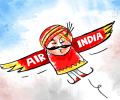
With the new owner shelling out Rs 18,000 crore for the buyout of 'Maharaja' this would be the highest ever amount garnered through privatisation or even the cumulative sum garnered through strategic sale in 1999-00 to 2003-04. The government had garnered roughly over Rs 5,000 crore during that five-year period by privatising 10 CPSEs.

Even if the Paytm fiasco does not mark the end of the bull run, at least some sanity will return to the wild IPO market, observes Debashis Basu.

After a hiatus of nearly two decades, the government's programme to privatise state-owned firms restarted with the handing over of debt-laden national carrier Air India to the Tata Group. With the new owner shelling out Rs 18,000 crore for the buyout of the 'Maharaja', this would be the highest-ever amount garnered through privatisation, and is even more than the cumulative sum mopped up through strategic sales from 1999-00 to 2003-04. The government had in October last year inked the share purchase agreement with the Tata Group for sale of national carrier Air India for Rs 18,000 crore. Tatas would pay Rs 2,700 crore cash and take over Rs 15,300 crore of the airline's debt.

Adani Wilmar (AWL) joined the elite group of companies with market capitalisation (m-cap) of Rs 1 trillion after the stock of Gautam Adani-led edible oil company hit a new high of Rs 802.80, up 5 per cent on the BSE in Tuesday's trade.
Divestment of public sector companies gathered steam in the first year of UPA-II that saw two PSUs-- Oil India and NHPC-- raising around Rs 8,600 crore (Rs 86 billion) from IPOs and the way was cleared for divestment in three more state-run power companies in the new year.

'Earning expectations remain strong.'

Ajit Mishra, vice president, research, Religare Broking, answers your queries.

Loans for Indian airlines have dried up as banks have become cautious to lend to the sector.

In the past 10 trading sessions, shares of the state-owned company have shot up more than 50 per cent.

Global markets trends, inflation, release of industrial output data and quarterly earnings will dictate movement of the equity benchmarks this week, analysts said, adding that volatility might continue amid slew of announcements of macroeconomic data at the global level too. Moreover, foreign fund movement, crude oil prices and trend in rupee would also act as major drivers for the equity market, they added. "The direction of global equity markets along with movement in dollar index and crude oil prices will continue to dominate while inflation numbers of the USA on May 11 and inflation and IIP numbers of India on May 12 will also cause volatility in the market," said Santosh Meena, head of research, Swastika Investmart Ltd.

The Centre's push to sell Air India on priority has led to delays in other strategic divestment proposals, such as privatising United India Insurance, as well as ongoing transactions, such as Shipping Corporation of India (SCI) and Bharat Petroleum Corporation (BPCL), revealed multiple officials involved in the process. The Department of Investment and Public Asset Management (DIPAM) is yet to take new privatisation recommendations of the NITI Aayog to the core group of secretaries on disinvestment (CGD) headed by the Cabinet secretary, said one of the officials. The priority now is to ensure all approvals for Air India are in place since the government intends to hand over the national carrier as early as this month.
'The selling in India may emerge as soon as the RBI reverses its interest rate stance.'

Finance Minister Nirmala Sitharaman on Tuesday said the Russia-Ukraine crisis and the ensuing jump in global crude prices are a challenge to financial stability in India. The two issues were discussed at the meeting of Financial Stability Development Council (FSDC), which comprises all the financial sector regulators, Sitharaman told reporters in Mumbai. "It is difficult to say how it (crude prices) will go.

India is massively underexplored, says Rahul Shir, CEO, Cairn India.

'Calendar year 2023 is going to be big as pessimism takes a back seat.'

'The business continuity clause will mean the Tatas will have to keep running the airline for three years, and cannot exit the flying business.'
Ajit Mishra, vice president, research, Religare Broking, answers your stockmarket queries.

'We would love to have more players entering the market because that is how the business will grow.'

So which sectors are likely to do well in 2022? Should you focus on domestic economy-related sectors or export-oriented ones?
Oil and Natural Gas Corporation is examining investing $3 billion to take up to 5 per cent equity in Russian state oil firm OAO Rosneft, which is making an initial public ofering, Petroleum Secretary M S Srinivasan said on Friday.

Rebalance your portfolio in case it has become overweight on equities vis-a-vis your strategic asset allocation.
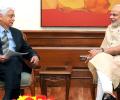
He is betting on emerging firms to generate ideas and build wealth through Premji Invest

'Largely, new demat accounts are now being opened by the younger crowd, particularly GenZ.' 'This is great news since younger investors start their journey with very little capital, so they are risking less.'

'This is a good time to restructure your portfolio because the sectors and stocks that performed in the last bull market may not perform as much now.'

The government on Thursday fixed Rs 358 a share as the floor price for up to 10 per cent stake sale in Coal India on Friday, which may help the exchequer garner about Rs 22,600 crore (Rs 226 billion) in the biggest sale of shares.

Equities went into a tailspin on Wednesday after the Reserve Bank surprised the market with a mid-cycle rate hike in a bid to tame soaring inflation.

As economic policy making moves from pragmatism to populism, the bulls begin to make way for cautious optimists.

Some of Modi's biggest reforms have met with fierce political opposition.

Rising for the fourth straight day, benchmark indices Sensex and Nifty settled marginally higher after a choppy session on Friday, tracking mixed global trends amid uncertainties on the geopolitical front. The BSE Sensex opened weak and declined 414.44 points to 55,049.95 in opening deals. But within minutes, it pared all its losses and jumped 369.56 points to 55,833.95. Facing volatility, the index finally settled at 55,550.30, higher by 85.91 points or 0.15 per cent.

'The government is trying to kickstart the investment cycle in India and while the corporate investments are yet to gather momentum, there are early signs of the same.'

Investors' wealth eroded by a massive Rs 8,21,666.77 crore on Monday as the market saw a massive sell-off not seen in many months. The BSE benchmark Sensex plunged 1,170.12 points or 1.96 per cent to close at 58,465.89. This is the worst single-day drop for the gauge in over seven months. This was also the fourth straight session of decline for the Sensex.

Ajit Mishra, vice president, Research, Religare Broking, answers your queries

ICICI Bank was the top gainer in the Sensex pack, rising over 3 per cent, followed by ITC, SBI, HCL Tech, Axis Bank, Bajaj Finserv and Tech Mahindra. NSE Nifty advanced 32 points to 15,856.05.
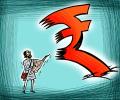
For first time in 8 yrs, stake sale proceeds could exceed Budget Estimates. ONGC's acquisition of HPCL alone could get the exchequer more than Rs 30,000 crore.

'We began foolishly bragging about Saudi-Emirati investment plans as indicative of the sheikhs 'distancing' from Pakistan, including on Kashmir,' notes Ambassador M K Bhadrakumar.
